Head-to-Head: Denon Home Sound Bar 550 vs Jbl Grip (Detailed Comparison)
Introduction
Choosing the right audio solution often comes down to matching the product to the intended use. The Denon Home Sound Bar 550 and the Jbl Grip approach sound differently: one is a compact, home-focused soundbar designed to enhance TV and music playback in a living-room setting; the other is a portable speaker intended for on-the-go listening. This comparison looks beyond marketing copy to evaluate real-world performance, everyday usability, and the buyer considerations that matter most: sound quality for movies and music, connectivity, setup, portability, and long-term value.
What buyers typically care about
- Use case: Is the device for home theater, music in larger rooms, or portable outdoor listening?
- Sound quality: Clarity, bass extension, stereo width, and how well it handles dialogue and effects.
- Connectivity: HDMI eARC, optical, Bluetooth, Wi‑Fi, AirPlay/Chromecast and multiroom options.
- Expandability: Ability to add subwoofers/rear surrounds or integrate into an ecosystem for multiroom audio.
- Ease of use: Setup, remote control, mobile app support, and automatic room correction.
- Portability and battery life: For portable speakers, battery life, IP rating, and physical durability.
- Value: How much real-world performance is delivered for the price and where compromises lie.
In-depth review: Denon Home Sound Bar 550
Design and fit
The Denon Home Sound Bar 550 presents a compact, understated aesthetic that fits beneath most flat-screen TVs without dominating the room. It is designed for living rooms and bedrooms where a tasteful appearance matters. Build quality tends to be solid, with soft-touch finishes and a grille that blends with typical home décor. Its footprint suits apartment setups where space is at a premium but the owner still wants a noticeable upgrade from TV speakers.
Sound profile and performance
In practice the 550 aims to deliver a balanced presentation with particular attention paid to dialogue clarity and midrange definition — two areas where budget TV speakers often fall short. The soundbar typically produces a wider soundstage than the TV’s built-in speakers, lending a more cinematic feel to movies and series. Denon’s tuning emphasizes natural voices and controlled bass, which results in a pleasant listening experience for both dialogue-heavy content and vocal-centric music.
For movie fans, the 550’s virtual surround processing provides a sense of height and immersion for compatible content. While it cannot match a full discrete surround setup with separate up-firing modules, it provides a meaningful improvement for users who need simplicity. The soundbar also pairs well with an optional wireless subwoofer or rear speakers to add depth and genuine surround imaging when desired.
Connectivity and smart features
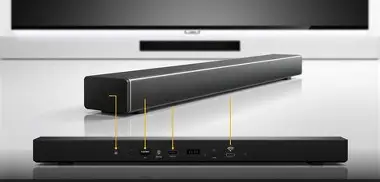
The Denon Home Sound Bar 550 focuses on modern TV connectivity: an HDMI input with eARC support for high-bandwidth audio passthrough, optical input for older TVs, Bluetooth for direct streaming, and Wi‑Fi-based features for multiroom integration. It commonly supports AirPlay 2 and Chromecast built-in along with Denon’s HEOS multiroom ecosystem, enabling music streaming across multiple rooms. The mobile app provides setup, EQ adjustments, and firmware updates — useful for owners who prefer to tailor the sound to the room.
Real-world use cases
The Denon is best suited for:
- Apartment dwellers or small living rooms who want a clear upgrade over TV speakers without adding a bulky AVR or multiple speakers.
- Users who watch a mix of movies and TV and want improved dialogue intelligibility.
- Owners who may add a wireless subwoofer later for deeper bass or who want to build a modest multiroom system using HEOS.
Pros & cons
- Pros: Clear dialogue, compact yet refined soundstage, HDMI eARC and modern streaming options, expandable with subwoofer/rears, tasteful design.
- Cons: Limited standalone bass compared with systems that include a dedicated subwoofer, virtual surround can’t fully replicate discrete surround speakers, price point may be high for buyers who only need portable playback.
In-depth review: Jbl Grip
Design and portability
The Jbl Grip targets portability and active lifestyles. It typically features a rugged outer shell, an integrated handle or strap (hence “Grip”), and an IP rating for water and dust resistance. The form factor is compact, engineered for easy carrying to a beach, backyard, or workshop. Materials emphasize impact resistance and practical durability over home furniture-friendly aesthetics.
Sound profile and performance
Portable speakers like the Jbl Grip aim to deliver surprisingly full sound from a small package. Expect boosted bass for a lively, punchy presentation and a forward midrange that makes vocals and pop music engaging when used close-up. Sound quality is impressive for casual listening, but the small drivers and passive radiators cannot reproduce the low-frequency extension or the wide, enveloping soundstage of a dedicated home soundbar. At higher volumes the Grip typically performs well outdoors, but it may lack the finesse for nuanced orchestral or cinematic passages.
Connectivity and battery life
The strong suit for the Grip is simple Bluetooth pairing and reliable wireless operation. Battery life varies by usage and volume, but the Jbl Grip is designed to last several hours of continuous playback. Some models include USB charging for phones and Bluetooth multipoint. There is little to no TV-focused connectivity — no HDMI or optical — because the speaker is optimised for mobile devices rather than fixed AV sources.
Looking for the best Audio & Headphones deals on Amazon?
Browse Now →Real-world use cases
Jbl Grip excels in scenarios like:
- Outdoor gatherings, picnics, or travel where portability, ruggedness, and battery life matter most.
- Personal listening and casual social playbacks where convenience beats absolute fidelity.
- Users who want a single speaker for daily routines — yard work, showers, or bike rides — and who prefer Bluetooth simplicity.
Pros & cons
- Pros: Highly portable and rugged, easy Bluetooth pairing, battery-powered for on-the-go use, good loudness and punch for its size.
- Cons: Not intended for TV or home theater use, limited low-frequency depth and stereo imaging, fewer advanced streaming or multiroom features compared with Wi‑Fi soundbars.
Head-to-head comparison table
| Criteria | Denon Home Sound Bar 550 | Jbl Grip |
|---|---|---|
| Primary use | Home TV and music; small-to-medium living rooms | Portable Bluetooth speaker for outdoor and mobile use |
| Sound character | Balanced, dialogue-forward, wider soundstage | Punchy, bass-forward, close-range listening |
| Low-frequency performance | Controlled, benefits from optional subwoofer | Boosted bass for size, limited deep bass |
| Connectivity | HDMI (eARC), optical, Wi‑Fi, AirPlay/Chromecast, Bluetooth | Bluetooth (solo), possible USB charging/aux on some variants |
| Smart / multiroom | Supports HEOS/AirPlay/Chromecast for multiroom setups | Typically not multiroom; focused on single-device streaming |
| Portability | Designed for stationary home use | Highly portable, battery-powered, rugged |
| Expandability | Can add wireless subwoofer and rear speakers | Not expandable in AV sense |
| Best for | TV/movies, music in room, multiroom enthusiasts | Outdoor parties, travel, casual daily listening |
How they compare in real-world scenarios
Watching movies and TV
For TV and movies, the Denon Home Sound Bar 550 is the clear choice. It improves dialogue clarity, supports higher-bandwidth audio paths via HDMI eARC, and produces a broader sense of space for on-screen action. The Jbl Grip cannot compete here — it lacks the inputs and processing needed for TV integration, and its stereo imaging and low-end weight are simply not tuned for cinematic content.
Listening to music at home
At home, the Denon again has the edge for sit-down listening. Its wider soundstage and multiroom capabilities make it a more versatile music player for living-room listening. The Jbl Grip, however, is lively for background or party music and excels when the listening situation is informal and mobile.
Outdoor and on-the-go use
If portability and ruggedness are priorities, the Jbl Grip wins hands down. Its battery operation and IP-resistance make it far more suitable for beach days, barbecues, or trips. The Denon is not portable and is intended to stay connected to a TV and mains power.
Integration and expandability
Buyers who want a simple, upgradeable home audio path will appreciate the Denon’s expandability: adding a wireless subwoofer or rear speakers improves immersion without redoing the system. The Grip is a single-unit solution with no meaningful path for true surround sound expansion.
Buying guide: Which one should someone choose?
Deciding between these two comes down entirely to how and where the product will be used. Below are practical considerations to guide the choice.
1. Define the primary use case
Choose the Denon if the main objective is improving TV sound, building a tidy home audio system, or enjoying music with a better stereo field. Choose the Jbl Grip for portability, outdoor durability, and casual listening away from home.
2. Room size and placement
Consider room size. The Denon works well in small-to-medium living rooms; large rooms may need a subwoofer and possibly rear speakers for fullness. The Grip is room-agnostic but performs best up close in open-air environments.
3. Connectivity needs
If the TV requires HDMI eARC to pass full-resolution audio formats or if integration with multiroom streaming (AirPlay/Chromecast/HEOS) is important, the Denon is the practical choice. If all playback will come from phones or tablets over Bluetooth, the Grip meets that need with simplicity.
Find top-rated Audio & Headphones products at great prices.
See Deals →4. Expandability and future-proofing
Denon’s ecosystem allows incremental upgrades. Those who like to start small and grow the system over time — adding subwoofers and surrounds — will appreciate the flexibility. The Grip is essentially final form: portable and ready to use, with no expansion for surround sound.
5. Budget and value
Evaluate total cost of ownership. A Denon soundbar can represent a larger upfront investment than a portable speaker, especially when adding subwoofers or rear speakers. However, for home use this investment buys substantially better cinematic performance. The Grip is usually far less expensive and delivers strong perceived value for portable use.
6. Practical setup and maintenance
Consider installation and day-to-day operation. The Denon requires placement under or in front of a TV, cable management, and potentially an app for setup. The Grip needs little more than Bluetooth pairing and periodic charging. For users who dislike tinkering, the Grip is nearly hassle-free; for those who want tailored sound, the Denon’s app and setup options are valuable.
7. Gaming and latency
For gamers, HDMI eARC and soundbar processing present the best option for low-latency, synchronized audio with the TV. Bluetooth speakers typically introduce latency that can be noticeable in games, making the Grip a less suitable pick for serious gaming unless used with devices that support low-latency codecs and the gaming sensitivity is low.

Setup tips to get the best performance
- For the Denon: Place the soundbar centered under the TV and avoid blocking tweeters with decorative objects. Use HDMI eARC for the best audio formats and turn on any dialogue-enhancement or night modes if late-night listening is frequent. If bass is lacking, consider an optional wireless subwoofer placed near the TV wall or a corner for reinforcement.
- For the Jbl Grip: Keep the speaker elevated and unobstructed for the cleanest sound. Charge fully before long outings and consider a small soft-case for protection during travel. Use moderate volume levels to preserve battery life and avoid prolonged maximum-volume blasts which can stress the drivers.
Conclusion
The Denon Home Sound Bar 550 and the Jbl Grip serve different needs and do so well. The Denon is a compact, capable home soundbar that meaningfully improves TV dialogue, music at-home playback, and offers expansion for fuller sound. It is the sensible choice for buyers prioritizing home theater, connectivity, and future expandability.
The Jbl Grip is a portable, rugged speaker tailored for life on the move. It offers convenience, simplicity, and battery-powered playback for outdoor and casual daily situations. It is the right choice for someone who values portability above cinematic fidelity.
In short: pick the Denon Home Sound Bar 550 for stationary home audio and better TV/movies; choose the Jbl Grip for portable, weather-resistant music playback. Both deliver value in their intended context — the key is matching the product to how and where it will be used.